
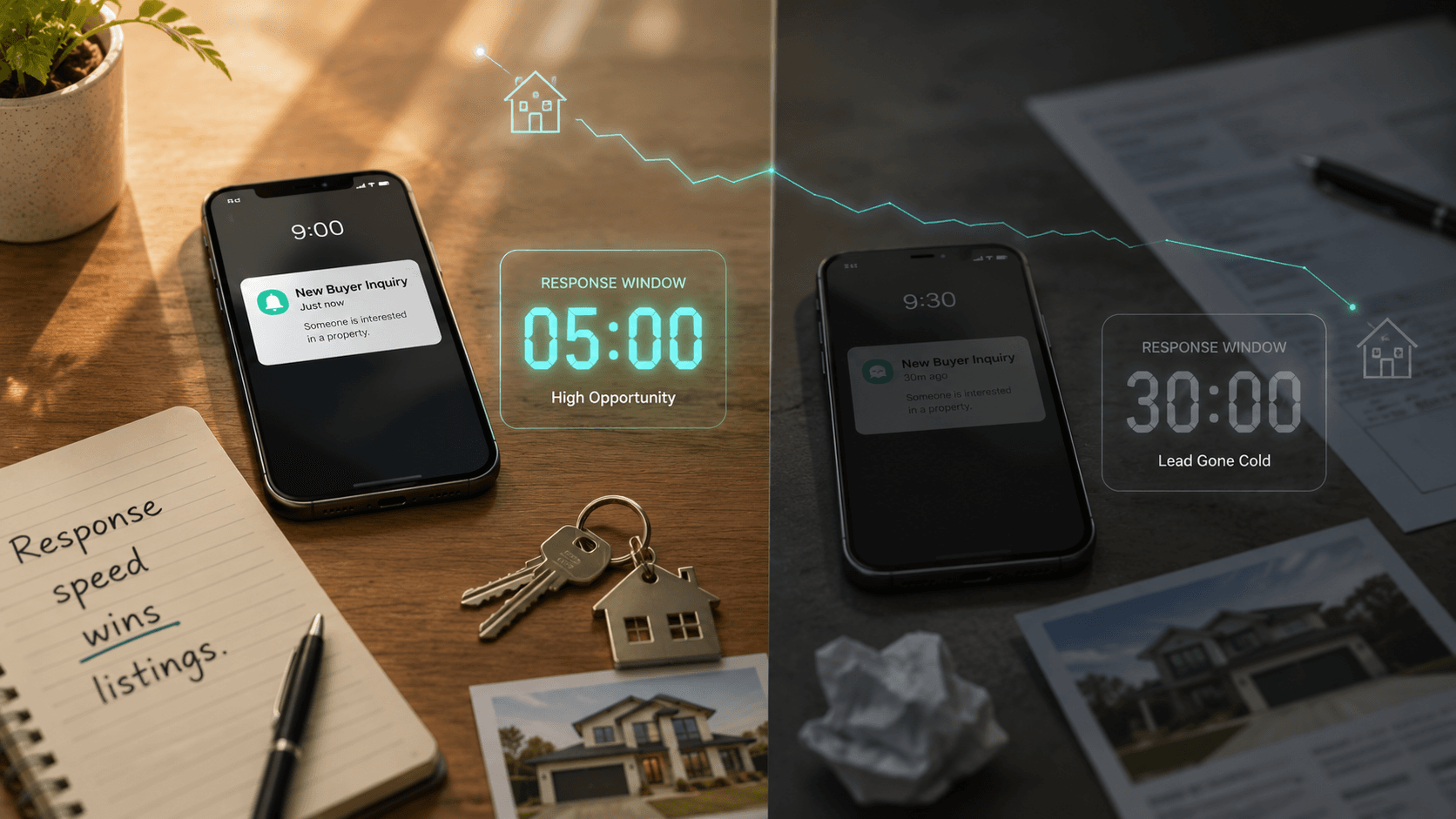
In 2011, researchers from MIT and Harvard Business Review published a study on lead response time in B2C sales. Their central finding: the odds of qualifying a lead drop by 21 times if you wait 30 minutes to respond versus 5 minutes. The window during which a lead is most reachable and most willing to engage is measured in minutes, not hours.
That study is now 15 years old. The finding has only become more accurate.
The digital lead environment in real estate has intensified every expectation the 2011 study described. A buyer who submits an inquiry on Zillow at 9pm on Sunday is simultaneously looking at three other properties on Realtor.com. They're texting their spouse, running the commute calculation on Google Maps, and opening the listing agent's website. The moment they submit that form, they are maximally engaged with buying a home. The window where you can reach them while they're thinking about your specific listing is short.
The math agents don't want to run
Most agents know they should respond faster. Few have actually run the numbers on what slow response costs them.
Take a straightforward example. An agent receives 20 new leads per month from paid sources — Zillow, a Facebook ad campaign, their IDX website. At an industry average response time of 4+ hours (the actual average, not the stated intention), roughly 60–70% of those leads have either gone cold, responded to another agent, or lost momentum before any contact is made.
That leaves 6–8 potentially reachable leads per month from 20. At a 10% lead-to-client conversion rate and an average commission of $12,000, slow response is costing a meaningful amount of revenue per year before accounting for the ad spend that generated the unreachable leads in the first place.
The 2024 National Association of Realtors data reinforces the asymmetry: 77% of recent home sellers contacted only one agent before choosing representation. The agent who responds first frequently wins the listing without a competitive process. That statistic is worth reading twice.
Why agents don't fix this without AI
The obvious response to the data is: respond faster. Call or text every new lead within 5 minutes.
The obvious response is also operationally unrealistic for most agents.
A solo practitioner has showings, listing appointments, paperwork, and a personal life. The 10pm Sunday lead arrives when the agent is asleep. The 2pm Tuesday lead arrives in the middle of a showing. The agent who responds within 5 minutes consistently — not occasionally — is either staffed with a dedicated inside sales agent, or they're using AI.
Human ISAs (inside sales agents) solve this problem at team scale. They're expensive ($35,000–$50,000/year for a competent one), require training and management overhead, and still create gaps for weekends, sick days, and high-volume periods. At the commission economics of most solo practices, a full-time ISA doesn't pencil.
AI ISA tools emerged to fill this gap. They respond to new leads within 60 seconds of sign-up, run qualifying conversations via SMS, and alert the agent when a lead shows genuine intent to buy or sell. The economics are different: $400–$800/month versus $40,000+/year, with no management overhead and no days off.
What AI lead response tools actually do
The tools in this category — Ylopo's Raiya AI, Structurely, and Real Geeks' Geek AI — are not chatbots in the sense most people use that word. They don't ask canned questions and present static information. They conduct multi-turn SMS conversations that qualify leads by timeline, motivation, and current housing situation, then escalate to a human agent when the lead is ready.
Ylopo's Raiya AI responds to new leads within 60 seconds via SMS and runs autonomous follow-up sequences for 90 days. The conversation is designed to identify where in the buying or selling process the lead actually is — not to push them toward a showing immediately, but to establish a relationship and identify the right moment for a human agent to step in. Raiya is available as an add-on to Ylopo's broader marketing platform and requires the full Ylopo subscription.
Structurely covers three channels — SMS, email, and voice — and includes live phone transfer when a lead qualifies. The live transfer is the differentiating feature: when a lead says "I want to sell in the next 60 days," Structurely can immediately transfer the call to the agent's phone rather than scheduling a callback. For high-intent leads, this eliminates the gap between AI qualification and human follow-up entirely.
Real Geeks' Geek AI is the most accessible entry point — it's included on the Grow and above plans and fires its first text within 2 minutes of lead sign-up. It's built into Real Geeks' broader IDX website and CRM platform rather than being a standalone tool, which makes it the easiest option for agents who want AI lead response without integrating multiple systems.
The integration problem most agents ignore
AI lead response tools are only as valuable as the leads flowing into them. The tools above need a lead source — your IDX website, Zillow, Facebook ads, a portal — to function. A tool that responds in 60 seconds to leads that arrive at inconsistent intervals because your lead gen is weak will not produce meaningful results.
The evaluation order matters: fix your lead generation before optimizing your lead response. An agent generating 5 leads per month needs better marketing more than they need AI ISA. An agent generating 40 leads per month who loses 60% of them to slow response has a response problem worth solving with AI.
The complete picture for a high-performing residential real estate practice in 2026 looks something like this: a CRM that manages the pipeline (Follow Up Boss or Lofty), an IDX website generating organic buyer leads (Real Geeks), an AI ISA handling first-touch follow-up across all sources (Raiya or Structurely), and a predictive tool identifying likely sellers before they list (Revaluate, Offrs, or SmartZip). No single tool does all of this well. The stack is the product.
The 5-minute window is real — and closable
The data on lead response time is not new, not contested, and not going to become less important as buyer expectations continue to shift. What has changed is that the technology to close the gap now exists and is accessible at solo-agent economics.
The question is no longer whether you should respond to leads faster. It's whether you're willing to let AI do it when you can't.
For a full breakdown of AI tools for lead response and pipeline management, see our best AI tools for real estate agents guide. For ISA-specific tools, see our reviews of Ylopo and Structurely.